
Why Sustainability and Due Diligence Now Decide Returns
The EU–Mercosur Agreement is back in the spotlight in 2026: on
January 17, 2026, the EU officially signed the package consisting of the
Partnership Agreement (EMPA) and the Interim Trade Agreement (iTA).
policy.trade.ec.europa.eu/…
At the same time, Europe is tightening supply-chain requirements through the
EU Regulation on deforestation-free products (EUDR) — including
geo-data evidence and stricter due diligence obligations.
environment.ec.europa.eu/…
For German buyers interested in agricultural real estate in Brazil, this creates a new reality:
- Trade may increase opportunities (market access, commodity demand, stronger international attention).
commission.europa.eu/…
- Regulation and sustainability compliance increasingly determine whether a farm remains marketable long-term (financing, exportability, exit).
environment.ec.europa.eu/…
This article brings both perspectives together: what EU–Mercosur means in practice —
and how to assess agricultural real estate in Brazil in a legally sound and sustainable way today.
1) Why EU–Mercosur fuels interest in Brazil — but does not automatically “push” land prices
The European Commission primarily justifies the deal through market access, competitiveness, and
strategic diversification.
commission.europa.eu/…
From an investor’s perspective, this can increase international focus on Brazilian agricultural and resource regions over the medium to long term — but:
land prices are not driven primarily by a trade agreement; they are driven by hard location factors:
- Productivity (soil, climate, management)
- Water availability
- Infrastructure (roads, ports, storage/logistics)
- Legal certainty (title, registries, cadastre)
- Environmental status (Legal Reserve, APP, CAR/PRA)
- Access to buyers/markets with compliance requirements
This is exactly where the new reality starts: the “value” of a farm increasingly depends on whether it is
supply-chain ready — i.e., whether it can realistically meet requirements such as EUDR compliance.
wri.org/…
2) Sustainability is no longer PR: EUDR changes the rules (from late 2026)


The EU EUDR (Regulation (EU) 2023/1115) aims to ensure that certain products sold on the EU market or exported from the EU
are not linked to recent deforestation or forest degradation.
environment.ec.europa.eu/…
Which commodities are relevant?
The EUDR names key drivers: cattle, wood, cocoa, soy, palm oil, coffee, rubber — including derived products such as
leather, chocolate, and furniture.
environment.ec.europa.eu/…
What must companies prove?
According to the EU, “operators” and “traders” placing these commodities on the EU market or exporting them must demonstrate
that the goods do not originate from recently deforested land and do not contribute to forest degradation.
environment.ec.europa.eu/…
WRI describes key requirements including the cut-off date of 31/12/2020 and the obligation to submit a
due diligence statement (including origin checks and geo-data) for EUDR-relevant goods.
wri.org/…
When does this apply?
The EU lists the start of application as:
- 30 December 2026 for large and medium-sized companies
- 30 June 2027 for micro and small companies
Source:
environment.ec.europa.eu/…
Important for agricultural real estate buyers: Even if you as an owner do not export directly to the EU:
banks, funds, offtakers, insurers, and future buyers increasingly look at whether land is
geo-data capable, verifiable, and low-risk.
wri.org/…
3) Brazil in the EUDR benchmarking: “Standard Risk” — what that means in practice
The EU operates a country benchmarking system with low / standard / high risk.
In the official EU list, Brazil is classified as “standard risk category”.
green-forum.ec.europa.eu/…
This is neither “all clear” nor “alarm” — it mainly means: requirements remain high (especially geolocation/traceability).
“Standard” is not “low”.
wri.org/…
For farm investments, this leads to one guiding question: Can this property reliably prove that its production is EUDR-compliant (or can be made compliant)?
4) EU–Mercosur & agriculture: Why safeguards and monitoring matter for Brazil investors too
The political debate in Europe also revolves around “sensitive agricultural products”. That is why additional
safeguards and close monitoring were anchored.
The EU Council describes a Mercosur safeguard mechanism as well as enhanced monitoring for TRQ products.
consilium.europa.eu/…
The European Parliament also refers to strict thresholds and regular market reporting.
europarl.europa.eu/…
Why does this matter? Anyone assessing a farm as an “export story” should understand: trade advantages are politically
conditional and can be reversed in disruption scenarios.
consilium.europa.eu/…
5) Buying agricultural real estate in Brazil: the legal guardrails (and typical pitfalls)
5.1 Foreign ownership restrictions: land deals are not “normal” real estate transactions
The purchase or lease of rural properties by foreigners (or foreign-controlled Brazilian entities)
is legally sensitive and in many scenarios requires approval. Depending on structure, requirements involving authorities/INCRA may apply;
in case of violations, the transaction may even be null and void.
madronaadvogados.com.br/…
Restrictions can also affect Brazilian companies that are directly or indirectly foreign-controlled
(e.g., via corporate transactions).
fgvw.de/…
5.2 Border zone: location can significantly change approval requirements
Properties in the border zone (faixa de fronteira, up to 150 km) can trigger additional approvals.
guella.adv.br/…
5.3 Alternative routes: funds & vehicles instead of direct purchase
For international investors, structured vehicles can be sensible. Chambers describes common entities and investment structures (e.g., FIIs/FIAGROs).
practiceguides.chambers.com/…
6) Environmental due diligence in Brazil: CAR, Legal Reserve, APP — and why this directly links to EU compliance
6.1 CAR & environmental regularity
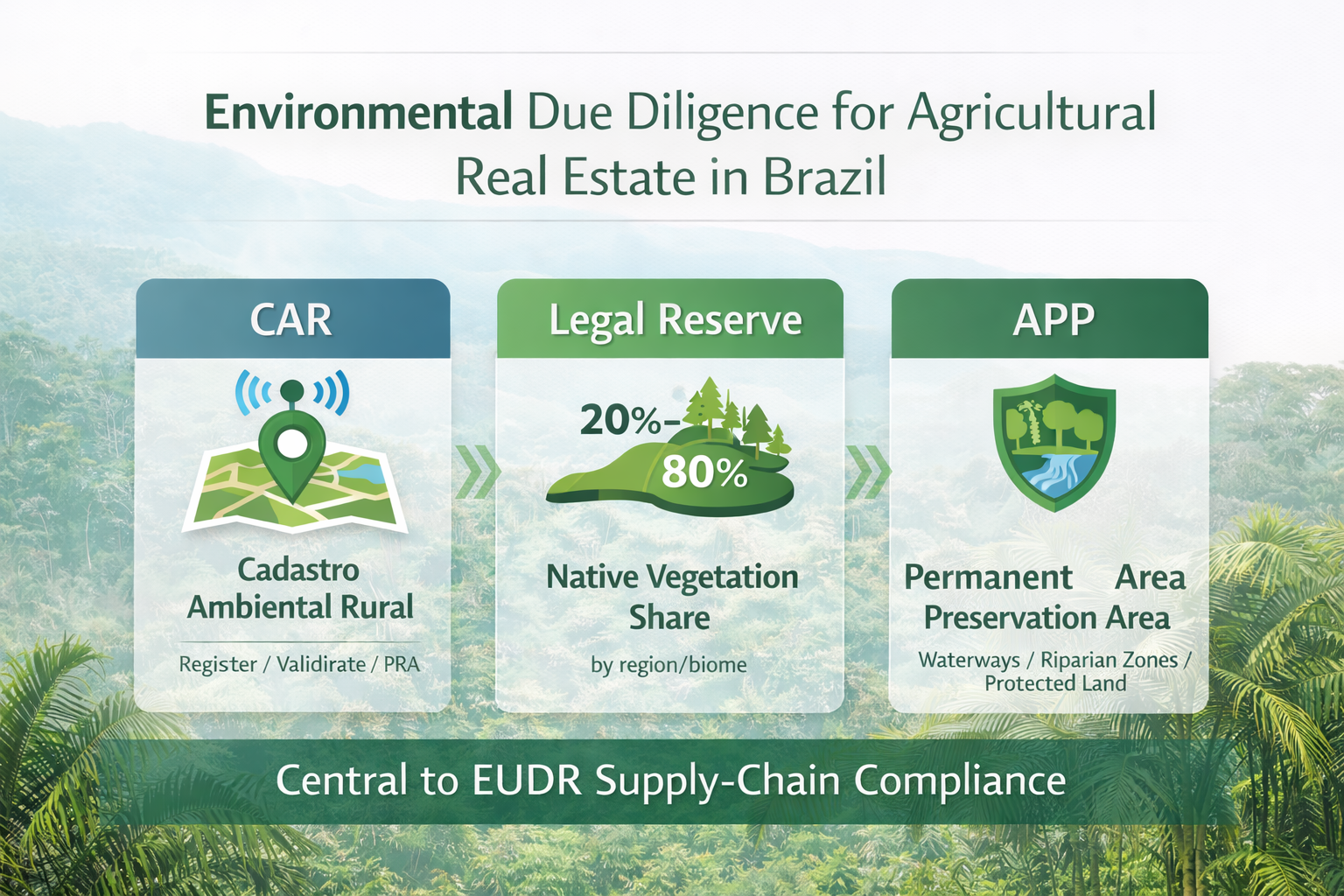
The Cadastro Ambiental Rural (CAR) is a central environmental registration instrument.
A GIZ factsheet describes registration, review/validation, and regularization.
giz.de/…
6.2 Legal Reserve: required shares vary strongly by region
The Climate Policy Initiative (CPI) explains the Legal Forest Reserve as a mandatory share of native vegetation — depending on region/biome, e.g. 20% to 80%.
climatepolicyinitiative.org/…
6.3 Why this is “gold” for EUDR
EUDR proof relies heavily on geolocation and comparisons against deforestation/degradation after the cut-off date.
wri.org/…
7) The practical due diligence checklist for agricultural real estate in Brazil (investor view)
Note: This is not legal advice, but a practical orientation.
A) Ownership & registry (title review)
- Chain of title via the competent registry/Cartório (Matrícula)
- Encumbrances, easements, boundary disputes, overlaps
- Complete documentation chain for a “clean” transfer
B) INCRA / rural registry / transferability
For transactions, it is often crucial whether the property is properly recorded in the rural registry.
A legal guide explains the role of the CCIR as an important document.
plbrasil.com.br/…
C) Tax & compliance basics
The ITR (rural property tax) is relevant annually; in transactions, proof is often required.
global.ecovis.com/…
D) Environmental status & land-use compliance
- CAR entry, validation status, PRA requirements
giz.de/…
- Legal Reserve quota (region-dependent)
climatepolicyinitiative.org/…
- APP areas, waterways, protected zones, embargoes (local data/authorities/tech)
E) EUDR readiness (if export/offtakers are EU-sensitive)
- Geo-data per plot (polygons) and traceable boundaries
- Risk analysis/monitoring (satellite checks, historical review)
- Documentation for due diligence statement requirements
wri.org/…
F) Acquisition structure / foreign ownership rules
- Check whether purchase/lease requires approval
madronaadvogados.com.br/…
- Check border zone (faixa de fronteira)
guella.adv.br/…
- Structure: direct purchase vs. vehicle/fund (e.g., FIAGRO/FII)
practiceguides.chambers.com/…


8) Conclusion: Anyone assessing agricultural real estate in Brazil in 2026 must connect trade and sustainability
EU–Mercosur can further internationalize Brazil — but the decisive value question increasingly is:
Is the property “future-proof” in terms of legal certainty, environmental regularity, and supply-chain compliance?
With the EUDR, verifiability (geo-data, deforestation status, local legality) becomes hard currency.
wri.org/…
And since Brazil is officially classified as standard risk, the topic remains relevant for all EU-adjacent sales paths.
green-forum.ec.europa.eu/…
Those who verify, structure, and document properly can seize opportunities — without getting tangled in legal or ESG risks.