Property Management Software 2026: From Excel to Cloud and AI
Property management is no longer just about filing cabinets, phone calls and bank transfers. Modern property management companies now work with complex software systems. They record payments, prepare statements, manage documents and handle payment transactions. At the same time, more and more information needs to be available digitally.
That is why powerful property management software in 2026 has become almost essential for professional property managers. However, the road to this point has been a long one. At Koch & Kollegen, things also started much more simply.
In an episode of Immobilientagebuch, Jaqueline Hartmann talks about this development and explains how her own property management business has changed over the years. The journey led from paper and Excel to local software, server-based solutions and finally modern cloud software with AI support. One thing quickly becomes clear: digitalisation in property management is not an end in itself. Instead, it is about saving time, reducing errors and remaining efficient despite growing demands.
What Does Property Management Software Actually Do?
A property management company handles many different tasks related to a property. In general, these tasks can be divided into technical and commercial property management. Technical management includes repairs, property inspections and the coordination of contractors. Commercial management, on the other hand, focuses mainly on figures, contracts and payments. This is exactly where software plays a central role.
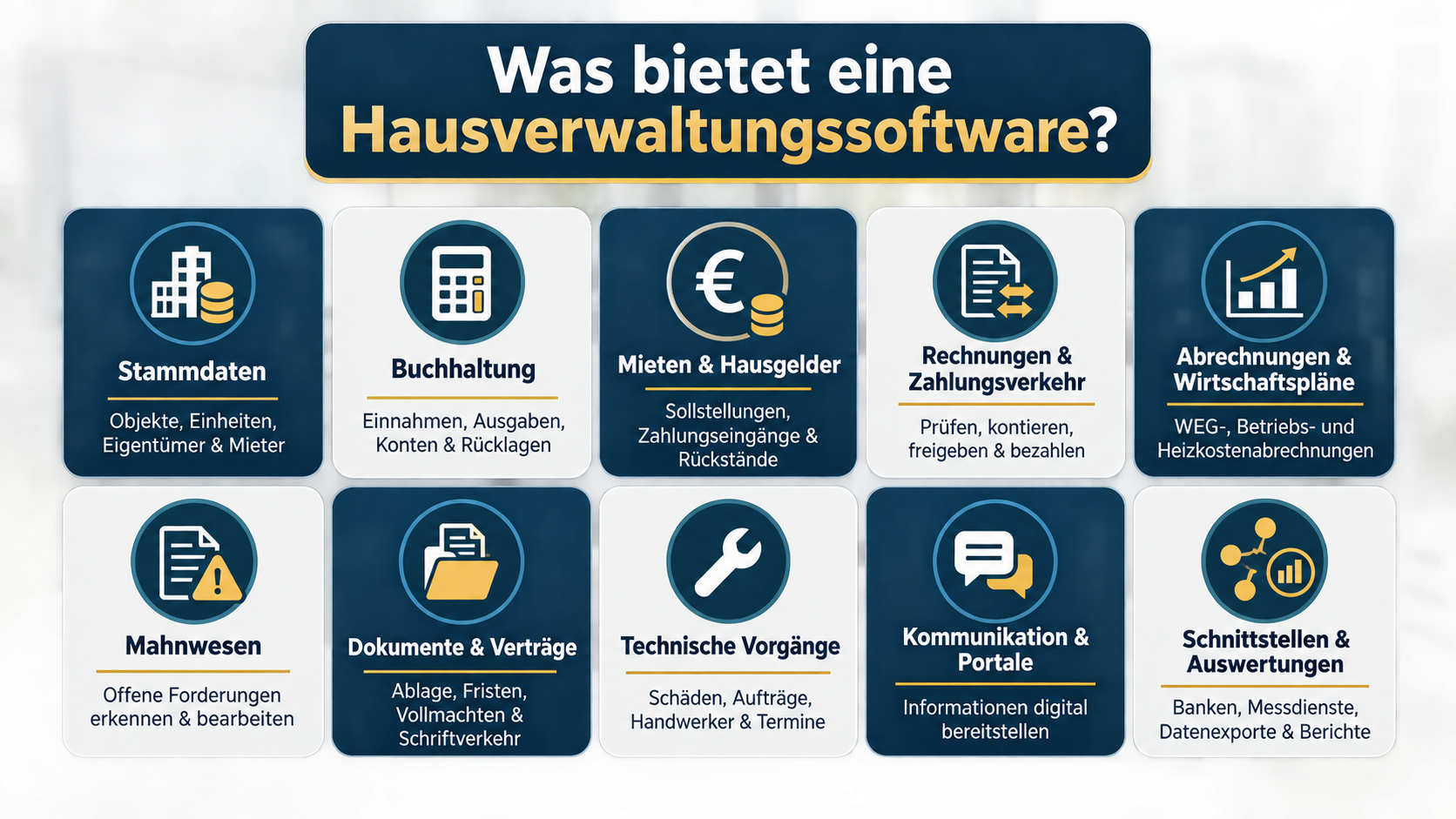
Tenants pay rent, while owners pay service charges or other contributions. At the same time, expenses arise for water, heating, insurance, waste disposal, caretaking services and repairs. All of these payments and costs need to be recorded correctly and later included in the relevant accounts. In addition, a property manager must be able to identify outstanding payments. If a tenant fails to pay, the arrears must be visible. Annual statements, operating cost statements, budgets and many other tasks also need to be handled. With only a few apartments, much of this can still be organised manually. As the portfolio grows, however, this quickly becomes more difficult.
Property Management Used to Rely on Paper and Filing Cards

Before computers became standard office equipment, property managers carried out their work entirely on paper. Incoming payments were entered into lists, costs were recorded separately and statements were prepared manually. In some cases, rents were even collected in cash. Not every tenant had a bank account in the past, so property managers sometimes had to take the cash to the bank themselves.
Day-to-day accounting also consisted of numerous lists and filing cards. One list might show rental payments, while other sheets recorded costs for water, electricity, insurance or other services. This system could work, but it required a great deal of time. In addition, every new property increased the risk of losing track of individual details. The old saying that written records are essential therefore had a very practical meaning in property management.
Excel Was the Next Step for Many Property Managers
Computers made many processes easier. At Koch & Kollegen, digital property management also began with Excel. For small portfolios, this was a practical solution. Spreadsheets could be customised, while income and expenses could be recorded in a clear and structured way.

At the beginning, Jaqueline Hartmann managed only a small number of properties. Therefore, she could monitor rent payments directly via the bank accounts. She used Excel spreadsheets for operating cost statements and other calculations. At first, this worked well. However, the workload increased with every additional property. Of course, Excel can be extremely powerful. Formulas, linked spreadsheets and complex calculations allow users to build surprisingly sophisticated systems. Even so, everything depends heavily on how the spreadsheets are created and maintained. As soon as several employees need to work at the same time or more specialised requirements arise, this approach quickly reaches its limits.
Why Excel Eventually Reaches Its Limits
Professional property management requires more than a collection of well-designed spreadsheets. Accounting, master data, payments and annual statements need to work together. In addition, legal requirements can change. Rules for statements and documentation may also be updated. As a result, a self-developed Excel system has to be adjusted again and again.
There is also a growing risk of errors. Data may need to be entered several times or stored in different files. This can lead to different versions of the same information. Professional property management software, by contrast, brings these details together in one central system. Modern solutions can manage master data, record incoming payments, support dunning procedures and prepare statements. Online banking and document management are also standard features in many systems today.
The First Step Towards Professional Property Management Software
As the property portfolio grew, professional software became necessary at Koch & Kollegen. However, there was an unexpected problem at first: Jaqueline Hartmann was working exclusively with Apple computers at the time. Many established property management programs were designed only for Windows.
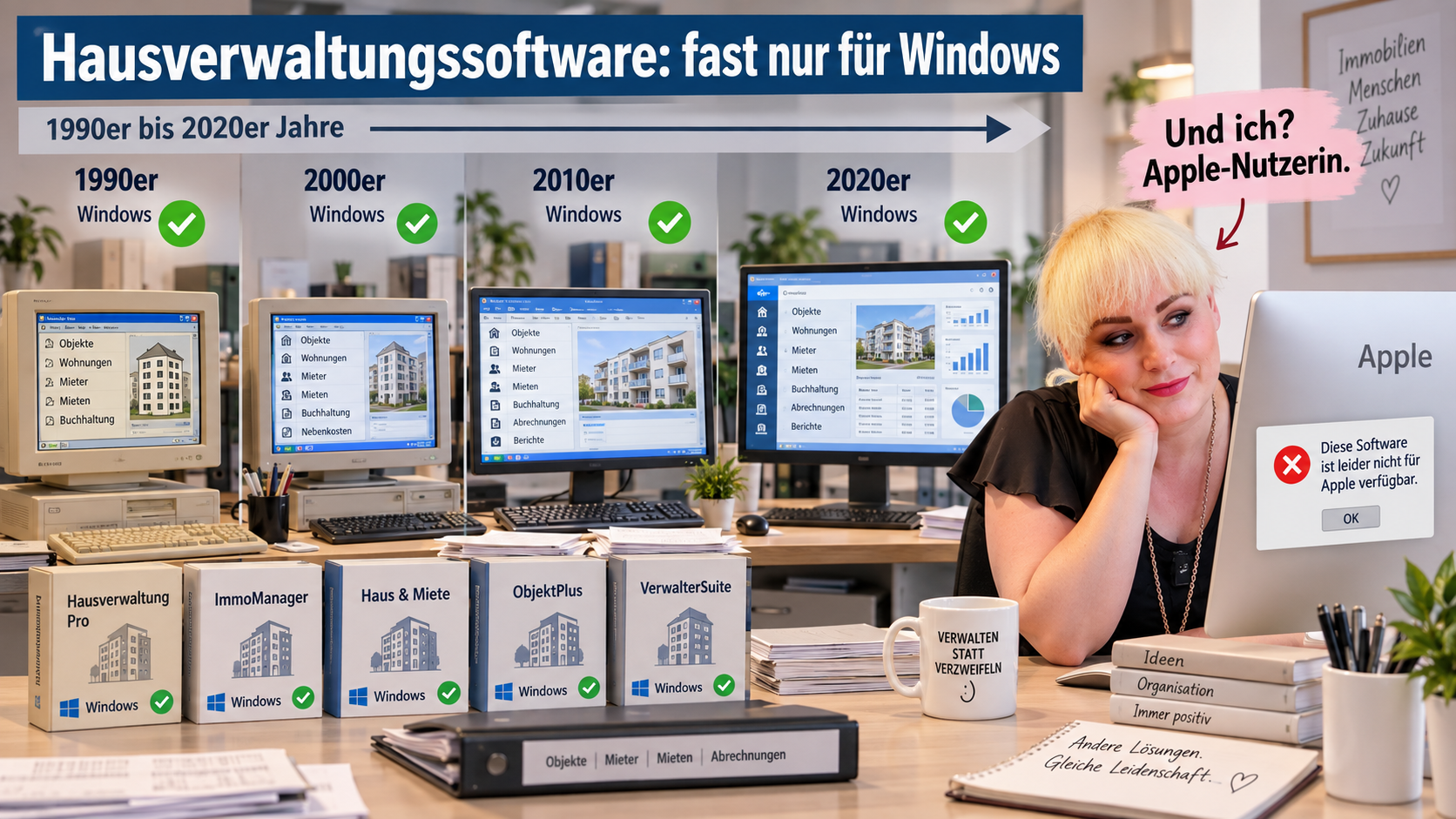
Initially, she found a solution with Intex, which could be used on a Mac. For smaller portfolios, the software was sufficient. However, it increasingly reached its limits when more complex tasks were involved. Condominium management in particular places high demands on software. Different allocation keys, cost categories and accounting methods need to be handled flexibly. Eventually, a fundamental change became necessary. The company did not only switch software. The entire computer environment also moved from Apple to Windows.
Haussoft Marked the Next Stage of Development
Haussoft, developed by the Berlin-based company GFAD Softwarehaus GmbH, became the new property management software. The system provides a wide range of functions for professional property managers. These include bookkeeping, dunning, financial accounting, operating cost statements, condominium accounts and online banking.
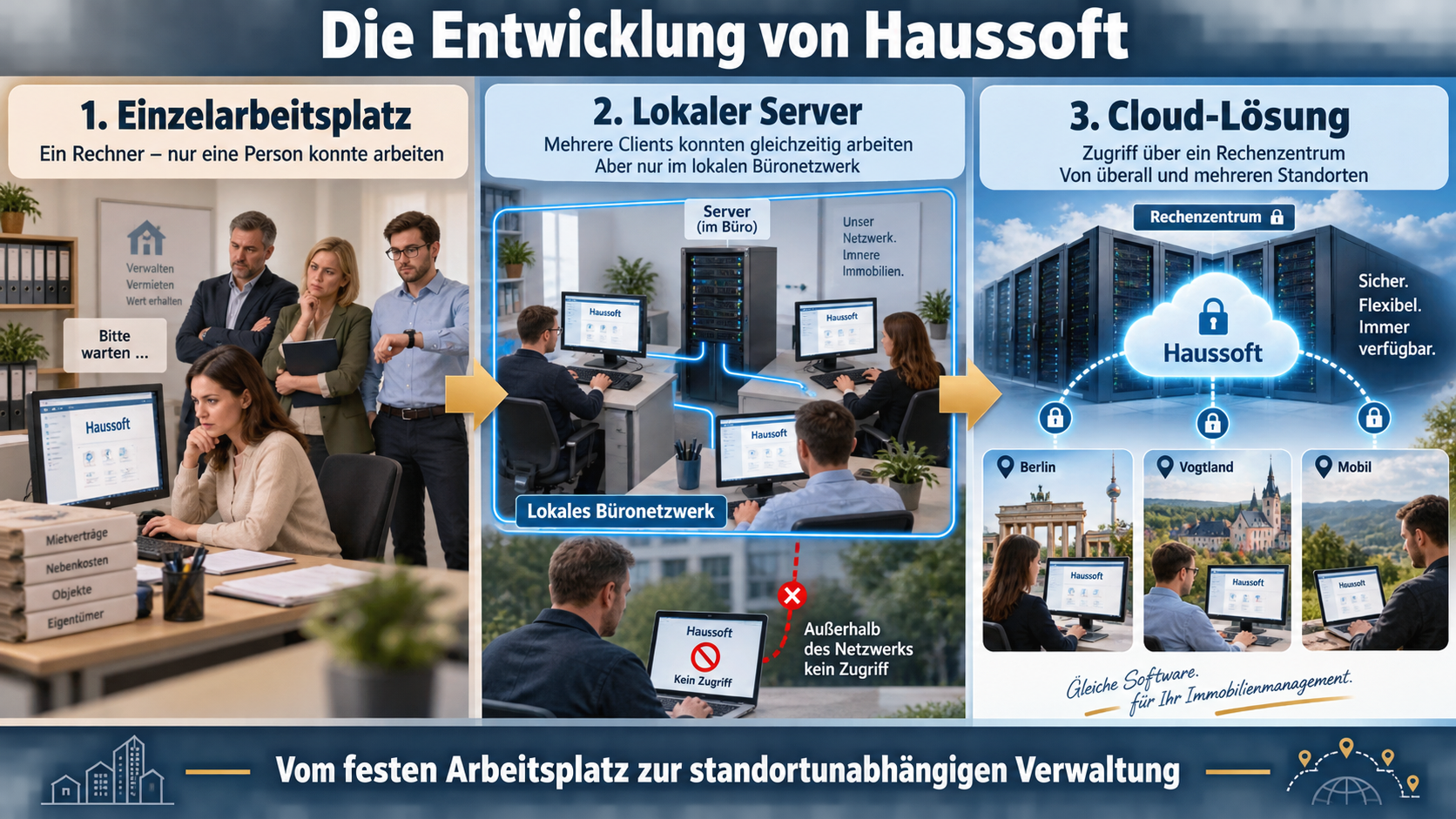
At Koch & Kollegen, the software was initially used on a single workstation. This also meant that only one employee could work in the program at any given time. For a small property management company, this model can work well. One person often handles both property supervision and parts of the accounting. However, as the team grows, a single workstation quickly becomes a limitation.
From a Single Workstation to an In-House Server
The next step was therefore a server-based solution. The property management software now ran centrally on an in-house server. Employees accessed the system from their individual workstations. As a result, several people could work with the same database at the same time. For the company, this represented a major improvement.
However, this setup also had a significant disadvantage. The server was located within the local network. Therefore, access mainly worked from inside the respective office. This became increasingly impractical for Koch & Kollegen because the company operates from different locations. Berlin and Saxony both needed access to the same property management data. Consequently, the next stage of development became increasingly important: the cloud.
Cloud Software Is Changing Property Management
With a cloud solution, the software is no longer installed only on a computer or server inside the office. Instead, it operates in a data centre or cloud environment. Employees can therefore access the system from different locations.
For a company with several offices, this is a major advantage. At the same time, part of the responsibility for maintaining local server technology is removed. Koch & Kollegen therefore later moved its Haussoft system into a cloud environment as well. This made location-independent work possible. Nevertheless, several issues remained from the company’s point of view. Speed, ease of use and connections to other digital applications became increasingly important.
Modern Property Management Needs More Than Accounting
The requirements for property management software have changed significantly in recent years. In the past, accounting was often the main focus. Today, owners also expect digital communication and quick access to documents. As a result, different customer portals have become increasingly important.
One example is ETG24. Property management companies can use systems like this to provide documents, manage service requests and carry out digital invoice checks. Owners can access statements, contracts and other information online. Ticket systems are also becoming more relevant. For example, an owner or tenant can report damage digitally, while the status of the request can be documented afterwards. This creates more transparency. At the same time, it can reduce the number of simple enquiries by phone or email.
Interfaces Are Becoming a Key Factor
However, a new problem arises when many different systems are used. Accounting may run in one program, while documents are stored in another. In addition, there may be a customer portal and separate software for owners’ meetings or metering service providers. If these systems cannot communicate with each other, the same data often has to be entered several times.
That is why open interfaces are becoming increasingly important. Modern software solutions try to exchange information between different systems automatically. For property management companies, this can make a significant difference. After all, every instance of duplicate data entry costs time. And in property management, time also means money.
Why Koch & Kollegen Is Changing Software Again
Despite the extensive range of features offered by Haussoft, the existing solution increasingly became a limitation for Koch & Kollegen. This does not mean that the software is unsuitable in general. On the contrary, Haussoft provides many detailed functions for professional property management. However, other factors became increasingly important for the company’s own workflows.
The interface needed to become more intuitive. Processes also needed to run faster. In addition, the team wanted a modern browser-based solution with open interfaces. While searching for an alternative, Koch & Kollegen eventually came across Impower. The company is currently in the middle of the transition.
What Is Different About Impower?
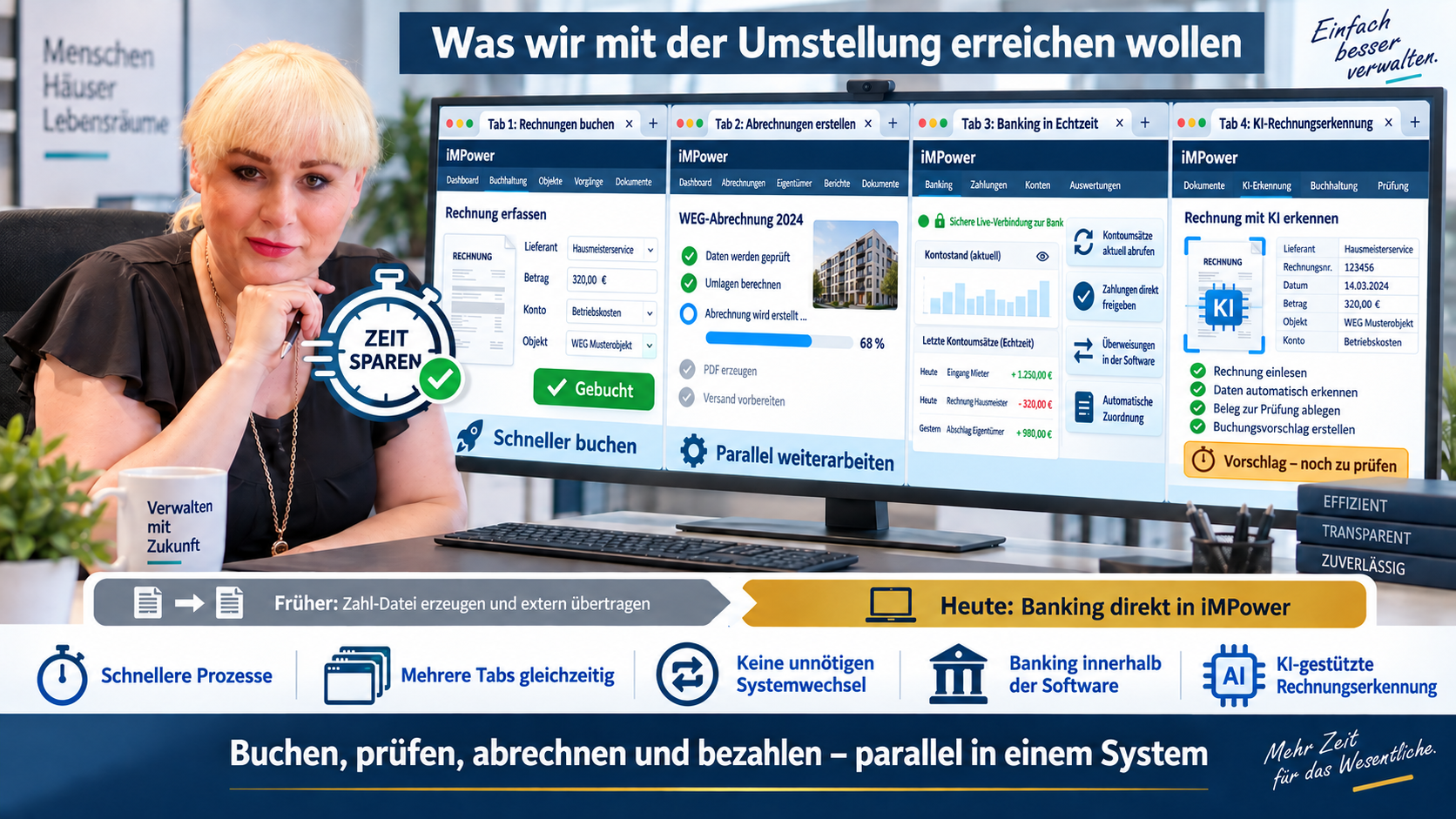
Impower is a cloud-based property management platform. It runs in a web browser, so there is no need for a traditional local installation for everyday use. This allows employees at different locations to work with the same system. The operating system used on the individual computer also becomes less important.
For Koch & Kollegen, the user interface was particularly interesting. Employees can also open several browser tabs at the same time. One tab can be used for accounting, while another can display different data or another task. This may sound like a small detail at first. However, in everyday work, such features can save a considerable amount of time.
Integrated Banking Reduces Additional Work
Payment transactions are another important area. Traditionally, many property management companies use separate banking programs. Payment files are first created in the management software and then transferred to another application.
Modern systems try to integrate payment processing directly into the main platform. As a result, an additional step can ideally be removed. This is particularly relevant for larger portfolios. After all, a property management company does not manage just one bank account. Depending on the number of properties, there can be many building and owners’ association accounts.
AI Is Entering Property Management
The increasing use of artificial intelligence is particularly interesting for Koch & Kollegen. Invoice processing is one example. Instead of entering every incoming invoice manually, software can automatically identify relevant information. This may include the supplier, invoice amount, property and other accounting details.
The software can then suggest how the invoice should be processed. As a result, the employee’s task changes. Information no longer has to be entered manually in every case. Instead, employees can review automated suggestions and make corrections where necessary. For companies that process large numbers of invoices, this can save a significant amount of time.
Automation Does Not Replace Property Managers
Even so, this development does not mean that software can replace professional property managers. Property management involves much more than bookkeeping. Owners need advice, decisions must be prepared, damage needs to be assessed and contractors have to be coordinated. In addition, individual situations arise every day that require human judgement.
Automation can, however, reduce routine work. If an invoice is recognised automatically or a payment is already assigned to the correct transaction, employees have more time for other tasks. This is exactly why digitalisation is interesting for us. The aim is not to make employees unnecessary. Instead, they should be able to use their time where their experience is genuinely needed.
Changing Software Is a Major Project
On paper, changing property management software may sound relatively simple. In practice, it is very different. First, master data has to be transferred. This includes properties, apartments, owners, tenants, accounts and many other details. Employees also need training.
At the same time, normal property management work continues. Tenants still pay their rent, invoices continue to arrive and owners still have questions. At Koch & Kollegen, there is another challenge as well. While the new system is already being set up, some older accounting periods still need to be completed using the previous software. Therefore, both systems have to operate side by side during the transition. A change like this requires time, planning and patience.
Digitalisation Initially Costs Money
In addition to the organisational effort, there is also a financial cost. Professional property management software is not free. Depending on the provider and pricing model, companies may pay licence fees, user fees or charges based on the number of managed units.
The transition itself also creates internal costs. Employees need training, data has to be checked and workflows must be reorganised. For that reason, a property management company should not judge new software only by its monthly price. The more important question is what long-term benefits the system provides. If employees can work faster, avoid duplicate data entry and automate routine processes, a more expensive system may still make economic sense.
Software Must Fit the Property Management Company
There is no single perfect property management platform for every business. A small company managing 50 units has different requirements from a company responsible for several thousand apartments. Rental management, condominium management and commercial property management also differ significantly.
Internal workflows are equally important. Some companies need highly detailed accounting functions. Others place greater emphasis on customer portals, mobile working or automated communication. Therefore, a simple list of features is not enough. It is just as important to consider how well the software fits into the company’s real working environment.
Property Management Software in 2026 Is Becoming a Central Platform
The direction of development is clear. Property management software is evolving from a simple accounting program into a central digital platform. Accounting, banking, documents, communication and customer portals are increasingly becoming connected. At the same time, automated systems are taking over more routine tasks. Artificial intelligence will also play a larger role.
However, people remain the decisive factor. Software can speed up processes, organise data, recognise invoices and provide information. Nevertheless, employees are still needed to review results, make decisions and communicate with owners, tenants and service providers.
For Koch & Kollegen, the current software transition is therefore another step in the development of its property management business. What started many years ago with Excel is now evolving into a cloud-based working environment with automated processes and AI support. Our goal remains the same: we want to manage properties reliably while continuously improving our internal processes. The more efficiently the company operates, the more time remains for what really matters – the properties and the people behind them.